Intranet continuous improvement: growing with your employees and your business
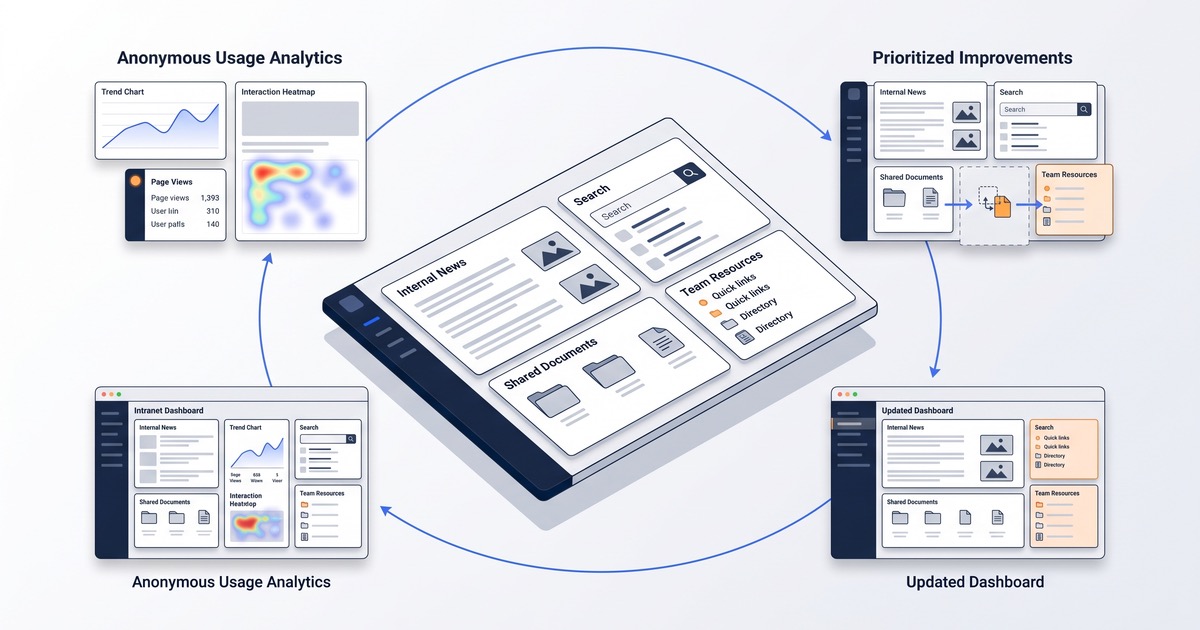
An intranet earns its place by helping employees get work done, not by staying faithful to its launch-day specification. Intranet continuous improvement means making today’s tasks easier while preparing for needs that did not exist when the project began.
Analytics can show where employees struggle. Conversations explain why. Business plans reveal what the platform may need to support next. Together, these inputs help you spend time and budget on changes that matter.
Open Intranet, a configurable and extensible Open Source product built on Drupal, gives teams room to adapt their implementation. The starting point is what the product already supports, with integrations or extensions considered when a real need justifies them.
In this article:
- Why should your intranet grow with your business?
- How do you discover needs that were not visible at launch?
- What can intranet analytics tell you about everyday difficulties?
- How does Open Intranet give you room to adapt?
- How do you decide what to improve next?
- How do you keep content and ownership in step with change?
- How do you build a roadmap that leaves room for new requirements?
- What should your next improvement cycle look like?
Why should your intranet grow with your business? {#why-improvement-begins-at-launch}
Delivering the agreed launch scope is a project milestone. Providing a useful workplace tool is an ongoing responsibility. A platform can meet its original requirements and still become less helpful as work changes.
New needs usually come from two directions:
- Employees discover them through use. They find that a task needs an extra step, a clearer handoff, or information from another system.
- The organization creates them through change. New locations, acquisitions, services, and reporting structures introduce requirements nobody could reasonably specify at launch.
Imagine a company opening another location. Employees there may need local guidance alongside company-wide policies. An acquisition could introduce a second directory or document system. A growing team might need an approval process that no longer fits comfortably into email.
These are not simply content freshness or page-view questions. They may call for new capabilities.
The aim is to adapt the intranet to useful business processes, rather than asking employees to work around the original configuration indefinitely. That requires an accountable owner, recurring review time, and a realistic improvement budget after launch. Without them, even well-understood problems can remain unresolved.
How do you discover needs that were not visible at launch? {#discover-emerging-needs}
Start with a question that reaches beyond the platform: “After visiting the intranet, what do you still have to do somewhere else?”
Not every outside task belongs on the intranet. But the answer can reveal recurring workarounds, repeated data entry, and unclear handoffs.
Ask employees to walk through a recent task. Where did they switch to a spreadsheet? Who did they email for clarification? Did they copy information into another tool? Could they tell what would happen next?
Keep these conversations short and include different perspectives:
- Employees from different locations, roles, and working patterns.
- Content owners who receive questions after publishing guidance.
- HR and managers who coordinate employee processes.
- IT teams who see access problems and integration dependencies.
Then compare what you hear with upcoming business changes. Hiring plans, reorganizations, new services, and replacement systems can all affect the intranet’s future role.
Separate an existing task that needs repair from a genuinely new requirement. For example, employees may initially need easy access to onboarding documents. Later, managers might request role-specific onboarding with assigned steps and visible handoffs. That is a potential process requirement to assess, not evidence that a complete workflow already ships with the platform.
Analytics cannot reveal a planned acquisition or fully describe a process employees have never been able to perform on the intranet. Discovery needs both observed behavior and forward-looking conversations.
What can intranet analytics tell you about everyday difficulties? {#read-intranet-analytics}
Read analytics as evidence about employee tasks, not as a scoreboard for the platform. Before reviewing a metric, decide what question it could help answer.
The available measures depend on your analytics tools, search setup, and instrumentation. The examples below are areas to investigate, not a list of native Open Intranet reports.
| Employee question | Evidence to review, where measurable | What to investigate |
|---|---|---|
| Can people find current information? | Search terms, zero-result searches, repeated queries | Missing content, unfamiliar labels, indexing issues, or access restrictions |
| Do people return to useful resources? | Repeat visits and resource usage trends | Whether a resource supports recurring work or requires repeated clarification |
| Is important content reaching its intended audience? | Aggregate content reach | Whether people know where to find it and whether the audience definition is right |
| Where does a task become confusing? | Task completion and abandonment at defined steps | Unclear instructions, unnecessary fields, or broken handoffs |
High page views are ambiguous. A policy page may receive many visits because it is useful. It may also receive repeated visits because employees cannot find a clear answer.
Pair usage data with support questions, feedback, and simple task tests. Ask someone to find the relevant policy and explain what they would do next. That observation can distinguish a navigation problem from unclear writing.
Compare trends over time rather than reacting to one reporting period. A seasonal HR task or an internal campaign can change traffic without indicating a lasting change in usefulness.
Use aggregate reporting and collect only what is needed. Compare employee groups only where privacy safeguards permit, avoiding breakdowns that could expose individuals in small teams. Individual activity should not become an employee productivity score.
The purpose is to identify barriers in the workplace tool, not to judge the people using it.
How does Open Intranet give you room to adapt? {#open-intranet-flexibility}
A useful intranet needs room for requirements that emerge after purchase. Open Intranet is a ready Open Source intranet built on Drupal, which gives teams several ways to evolve an existing implementation.
The Open Intranet documentation describes its Drupal distribution approach and options for configurable content structures, permissions, presentation, contributed modules, and custom extensions.
In practice, assess changes in this order:
- Use existing capabilities. Check whether the current setup already supports the task.
- Adjust configuration. Review content structures, navigation, permissions, and presentation.
- Assess compatible modules. Check their fit, support status, compatibility, and maintenance needs.
- Connect another system. Keep information or transactions in the appropriate business application where that makes sense.
- Develop a maintainable extension. Consider this when the requirement matters and existing options do not meet it.
For example, a reorganization might require different publishing approvals. A newly adopted HR system could create a need for a connection. An employee request handled through email might justify a structured process. Each needs a fit and feasibility review, including permissions, dependencies, and ongoing support.
Some subscription products also provide useful integrations and extension options. The question is whether those options support your actual requirement and on what terms. If a chosen service does not expose the capability or extension point you need, you may have to consider another plan, another service, a workaround, or a vendor roadmap commitment.
With Open Intranet, teams can explore changes to their own implementation rather than relying exclusively on a closed product vendor adding a feature to a package.
Access to code creates options, not unlimited feasibility. Configuration, integration, development, testing, upgrades, and maintenance still need skills and budget. Start with supported configuration and maintainable extensions, not a blank-slate rebuild or direct changes to Drupal core.
How do you decide what to improve next? {#prioritize-improvements-from-data}
Keep one improvement list that covers current frustrations, emerging employee needs, and upcoming business requirements. Separate lists can hide trade-offs and allow highly visible requests to displace more useful work.
Describe each item as a problem rather than a feature request:
Employees cannot reliably find the current travel policy because search results contain duplicate pages with different titles. A useful result would be finding the approved policy without asking HR.
Record who is affected, why the problem matters, and what evidence supports it. Then classify the likely work: content correction, configuration change, integration, or new development. Those categories have different delivery and maintenance implications.
Prioritize using a few practical questions:
- Impact and frequency: How much difficulty does this cause, and how often?
- Risk: Could incorrect information or a failed task cause harm?
- Business timing: Is a new location, process, or system creating a deadline?
- Confidence: Do observations support the proposed change, or is more discovery needed?
- Effort: What will implementation, testing, and ongoing maintenance require?
Two hypothetical problems show why diagnosis matters. Failed policy searches may need clearer labels and merged duplicates, not a new search tool. A newly introduced approval process may need a workflow or connection to another system, not another help page.
For Open Intranet, check configuration and supported components before commissioning an extension. A module’s existence does not establish that it fits your implementation.
Try the smallest useful version with affected employees. Assign an owner and agree how you will assess the result before starting. When comparing before and after, account for seasonal demand, staffing changes, and communications campaigns.
How do you keep content and ownership in step with change? {#keep-content-and-ownership-current}
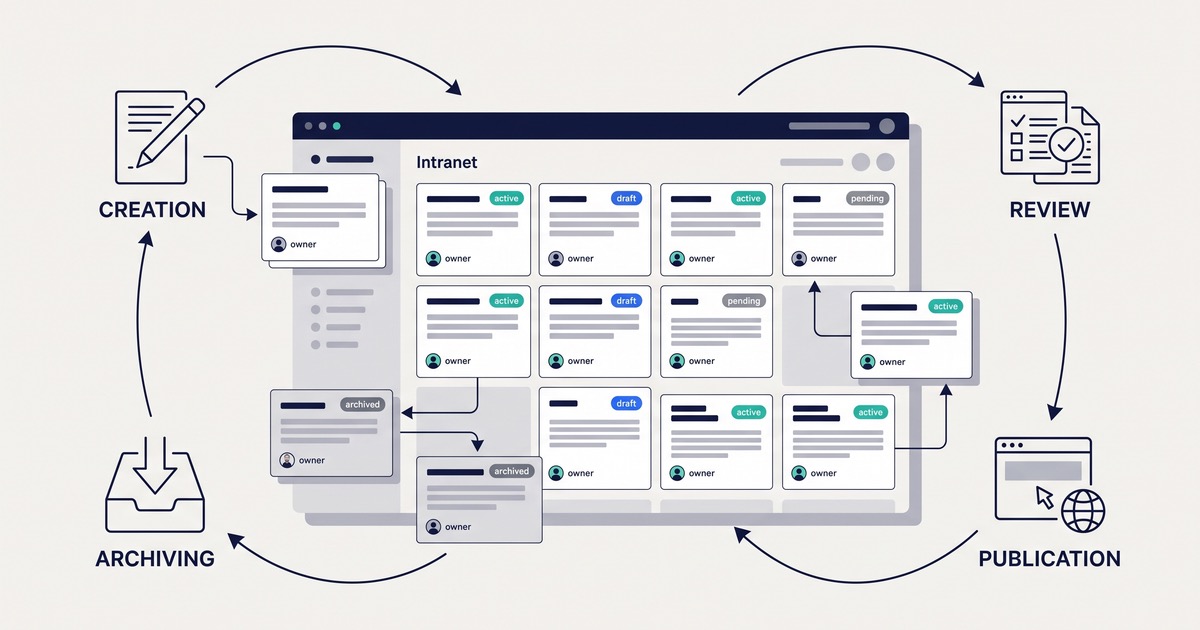
Stale content costs employees time and can lead them toward the wrong process. The risk grows when organizational changes leave pages without a clear owner.
Give important pages an owner and a review date. Base review frequency on how quickly the information changes and the consequences of an error. A frequently changing operational instruction needs different attention from a stable company history page.
An overdue review is one signal, not the only signal. Combine it with search demand, usage, employee feedback, and business risk when deciding what to update first. Rarely visited emergency guidance may still deserve urgent attention.
When teams merge or roles change, review four things together: content ownership, publishing approvals, audiences, and permissions. Changing an owner’s name without checking access or approvals leaves gaps.
Keep responsibilities clear without making every edit pass through multiple committees:
| Role | Main responsibility |
|---|---|
| Intranet owner | Priorities, decision-making, and unresolved ownership questions |
| Communications | Editorial guidance and company-wide publishing coordination |
| Content owners | Accuracy, relevance, and review of their information |
| IT | Platform operation, updates, and technical dependencies |
| Security | Access safeguards and risk review where needed |
Use reminders and workflow controls where available. Give editors a named contact when ownership is uncertain.
Update or merge duplicates, archive outdated material, and check retention requirements before deletion. Preserve useful routes to replacement information through updated links, redirects, or clear notices where appropriate.
When publishing workflows change, provide short editor guidance explaining what changed, who approves what, and where to get help. Governance works when responsibilities remain usable as the organization evolves.
How do you build a roadmap that leaves room for new requirements? {#build-a-multi-year-intranet-roadmap}
A multi-year roadmap should set direction without pretending to know every future feature. Plan around outcomes such as helping a new location find relevant guidance or reducing manual steps in employee requests.
Keep near-term commitments specific and later work conditional. For example:
| Planning horizon | Useful level of detail |
|---|---|
| Next improvement cycle | A defined problem, owner, proposed change, and result to check |
| Coming quarters | Prioritized outcomes, dependencies, and discovery work |
| Following years | Business direction, likely platform needs, and assumptions to revisit |
A quarterly priority review and an annual discussion of longer-term direction can be a practical starting rhythm. Adjust that cadence to the pace of change in your organization.
Bring business plans into these reviews alongside analytics and employee feedback. Otherwise, the roadmap may become very effective at fixing yesterday’s problems while missing tomorrow’s requirements.
Reserve capacity for discovery, content care, security work, updates, and new capabilities. Funding only visible additions can leave the platform harder to maintain and the team unable to investigate new needs.
For Open Intranet, map outcomes to ways of evolving the existing implementation: configuration, compatible modules, integrations, or extensions. Include the maintenance and upgrade implications of an extension in the funding decision. Development is not a one-time expense with no future obligations.
Also leave room to say no. A specialist system may be the right place for a transaction, with the intranet providing a clear route to it. Sometimes changing a process outside the platform will remove more friction than adding another feature.
The roadmap should protect business usefulness, not maximize the number of capabilities housed in one place.
What should your next improvement cycle look like? {#start-the-next-improvement-cycle}
Start with one current employee difficulty or one upcoming business change. A focused cycle is easier to test and learn from than a broad list of unrelated enhancements.
- Understand the need. Talk to the people affected and capture the current task or anticipated requirement. Note where time is lost, work is repeated, or responsibility becomes unclear.
- Check the current setup. Review what your Open Intranet implementation already supports. Identify the smallest useful change before considering additional development.
- Agree on ownership and effort. Name someone responsible, estimate delivery and maintenance needs, and define what progress would look like.
- Test with relevant employees. Check whether people can complete the task. Review content ownership, permissions, and integration dependencies where applicable.
- Observe the result. Allow enough time to see representative use. For an occasional process, this may mean waiting for the next real cycle rather than measuring a few days of traffic.
- Decide what happens next. Keep, revise, expand, or reverse the change based on what you learn.
- Close the feedback loop. Tell employees what changed and why, then use the findings to choose the next step.
Your evidence does not have to depend entirely on analytics. If the selected tools cannot measure task completion, a repeat task test or structured feedback may provide a more credible comparison than page views alone.
Intranet continuous improvement becomes sustainable when each cycle produces both a useful change and clearer evidence for the next decision.
Choose an intranet that leaves room for change
Listening to employees, learning from usage, and revisiting business priorities all point to the same conclusion: when choosing intranet software, look beyond what it can do at launch. Ask how you will adapt it when your needs change. You do not have to predict every future requirement, but it is worth choosing a platform that gives you ways to respond.
That is a reason to consider Open Intranet. As an Open Source product built on Drupal, it supports configuration and extensions, so you can adjust your implementation, connect new systems, and add functionality as new needs become clear. You can start with a ready product without making its initial feature set the permanent limit of your intranet.
Changes still need planning, testing, and a maintenance budget. The benefit is having options to develop your own implementation rather than depending exclusively on whether a supplier adds a feature to a closed product package.
Bring one recurring employee frustration and one upcoming business change to a conversation with the Open Intranet team. Together, we can explore what can be configured, what needs connecting, and what may justify an extension, so the intranet can keep helping your people as the organization evolves.